
Blog / November 21, 2026
ISO 22716 Checklist: How to Run a Cosmetics GMP Audit-Readiness Check
By Ersin Çetin, Lead Auditor, 25+ years in management system audits

An ISO 22716 checklist is a clause-by-clause self-assessment against ISO 22716, the international guidelines for cosmetics good manufacturing practice (GMP). Use it to walk your plant and sample records, from personnel and premises through production, the laboratory, complaints and documentation, so gaps show up before a certification audit, a brand-owner visit or a regulatory inspection. The checklist measures readiness; it is not a certificate, and it does not replace legal duties in the European Union or the United States.
ISO 22716:2007 gives guidelines for the production, control, storage and shipment of cosmetic products. It does not cover research and development, distribution after goods leave the site, or the safety of staff and the environment. If you need an independent certificate, see our page on ISO 22716 certification. Use the ISO 22716 audit checklist and seven steps below for the readiness check that should come first.
How to run an ISO 22716 audit-readiness check

Work through the plant in this order, and collect evidence you can show.
- Fix the scope. List the activities, buildings and product types you will check: manufacturing, filling, packing, storage and, if you have one, the laboratory. Mark research and development, distribution after goods leave the site, and anything you do not do as not applicable, and record why.
- Choose a checker who does not work in the area. ISO 22716 calls for periodic internal audits, so the person walking the plant should not check their own routine work. Gather procedures, specifications, recent batch records, cleaning and calibration logs, training records, and deviation, complaint and recall files. Our list of documents the auditor will ask for is a starting point.
- Walk the plant while a batch is running. Follow the material flow from goods-in to dispatch. Check hygiene and clothing at the line, status labels, the start-up or line-clearance record, and in-process checks as they are done. A paper review alone misses mix-ups and hygiene failures.
- Trace one released batch from receipt to dispatch. Pick a released finished batch and trace it back to raw-material and packaging lots, their release, equipment and cleaning records, in-process checks and laboratory results, and forward to where it was sent. A break in that chain will also show up in a certification audit.
- Sample the system records. Review recent out-of-specification investigations, deviations, complaints, recall records, change-control files, subcontractor agreements and the last internal audit plus its corrective actions. These ISO 22716 requirements are easy to skip if you only walk the filling line.
- Score every applicable clause and record evidence. For each item on the ISO 22716 audit checklist below, record whether it is met, a gap, or not applicable, and note the evidence (batch number, tank, record date). Treat unlabelled bulk, an expired hold time or released stock with an open investigation as a same-day quality issue.
- Close the gaps, then decide whether to apply. Correct product-quality problems first, then documentation and training gaps. When records show the system running as written, you can apply. ISO 22716 GMP certification with EUROTECH goes from a written quote to an on-site audit, an independent decision and yearly surveillance. The cost table on the service page starts at $800; see also our ISO certification cost guide and how to get ISO certified.
ISO 22716 checklist: requirements by clause
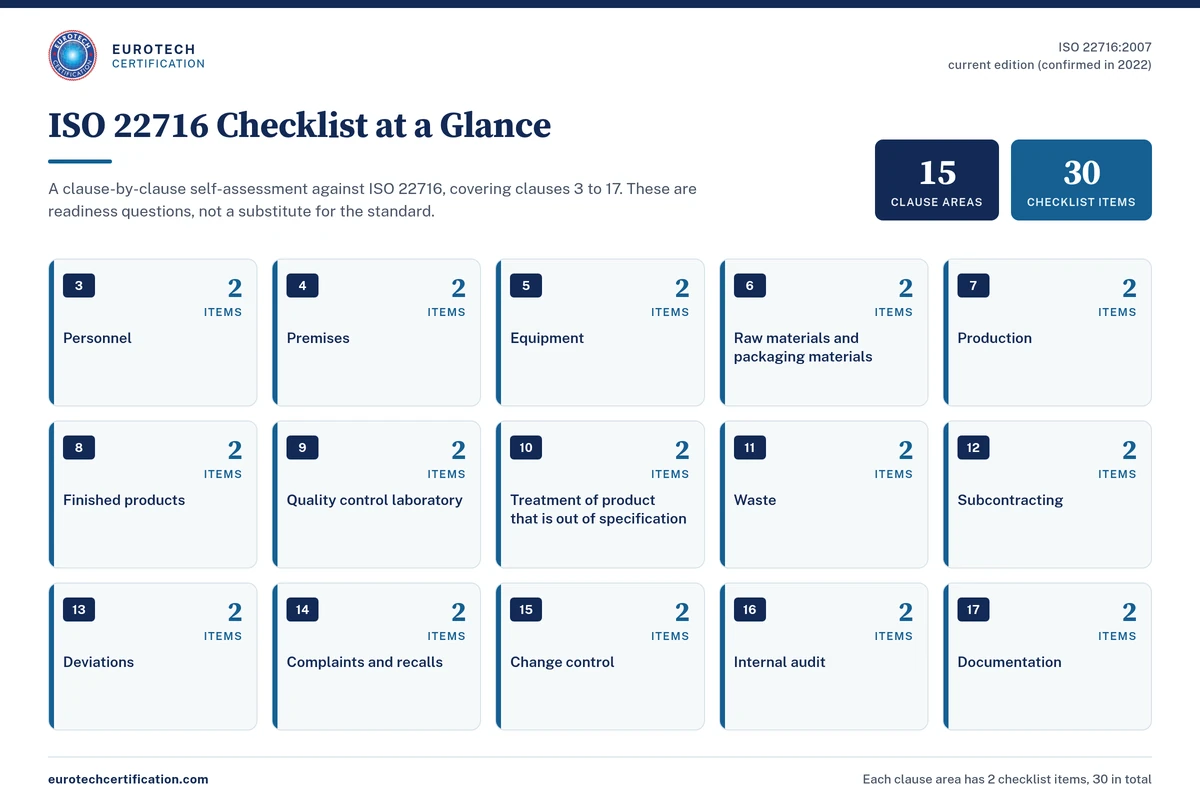
The items below follow clauses 3 to 17 of ISO 22716:2007, the current edition (confirmed in 2022). They are readiness questions, not a substitute for the standard. Adapt them to your products and tick only what is in scope.
3. Personnel
- Are roles defined, and are people trained for their GMP tasks, with records kept?
- Are hygiene and clothing rules followed in production and storage, including by visitors and contractors?
4. Premises
- Are areas laid out so materials and people can move without mix-ups or contamination?
- Are premises cleaned and maintained to a plan, with pest control in place and access to production controlled?
5. Equipment
- Is equipment suitable, identifiable, and maintained so it does not put product quality at risk?
- Are cleaning (and, where required, sanitisation) and calibration or checks of measuring instruments written, followed and recorded, with a clear equipment status?
6. Raw materials and packaging materials
- Do incoming materials have specifications, and are they checked and held until released?
- Are materials identified (name or code, batch or lot, and status), stored so they are protected, and traceable? If water is a raw material, is it produced and monitored to its specification?
7. Production
- Are operations carried out against approved instructions and recorded in a batch record at the time, with a batch number for each bulk and finished batch?
- Are start-up checks, line clearance and defined in-process checks done and recorded?
8. Finished products
- Are finished products checked against specifications and released by authorised quality personnel before they are placed on the market?
- Are released, quarantined and rejected products identified and kept apart, stored correctly, and labelled with name or code, batch number and, as applicable, quantity?
9. Quality control laboratory
- Do sampling and testing follow written methods, with results recorded and reviewed before release?
- Are reagents, standards, laboratory equipment and retained samples controlled? If testing is subcontracted, is that laboratory covered under clause 12?
10. Treatment of product that is out of specification
- Are out-of-specification materials and products identified, segregated and investigated?
- Is the decision to reject, rework or release taken by authorised people and recorded?
11. Waste
- Is waste collected, stored and removed so that it cannot contaminate materials or product?
- Is the destruction of rejected printed packaging recorded so it cannot re-enter production?
12. Subcontracting
- Are subcontracted activities that can affect product quality (for example filling, testing or packing) defined in a written agreement?
- Does the contract giver assess the contract acceptor and control what is received back?
13. Deviations
- Are deviations from procedures or specifications recorded, investigated and decided by authorised people?
- Are corrective actions identified and followed through?
14. Complaints and recalls
- Is there a written procedure to receive, investigate and record quality complaints, including identification of the batch?
- Is there a written recall procedure that can identify and recover affected product?
15. Change control
- Are changes that may affect product quality (formula, process, equipment, premises, specifications or suppliers) reviewed and approved before they are implemented?
- Are relevant documents and training updated after the change?
16. Internal audit
- Is there a planned internal audit programme covering the GMP system?
- Are findings recorded, and are corrective actions followed through to closure?
17. Documentation
- Are procedures, instructions and records controlled, current and available where they are used?
- Do batch, cleaning, laboratory and shipment records identify the product and batch, and can they be retrieved for the period you have defined?
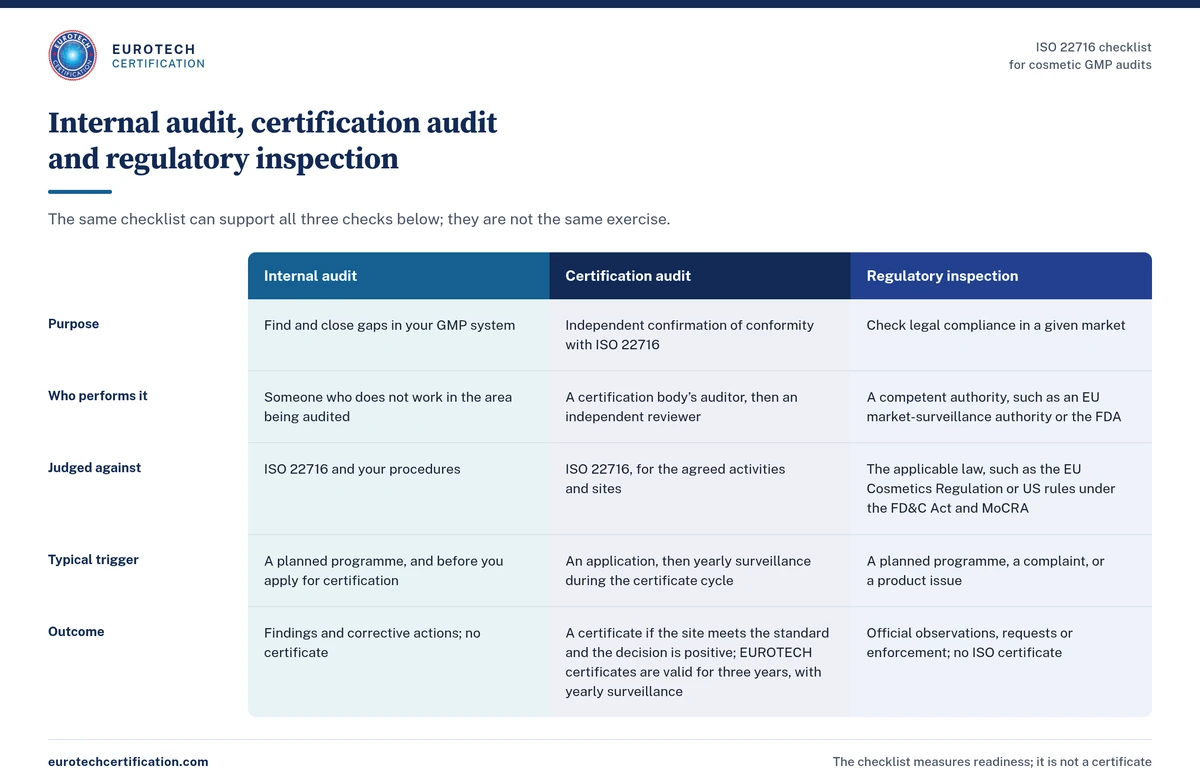
Internal audit, certification audit and regulatory inspection

The same checklist can support all three checks below; they are not the same exercise.
| Internal audit | Certification audit | Regulatory inspection | |
|---|---|---|---|
| Purpose | Find and close gaps in your GMP system | Independent confirmation of conformity with ISO 22716 | Check legal compliance in a given market |
| Who performs it | Someone who does not work in the area being audited | A certification body's auditor, then an independent reviewer | A competent authority, such as an EU market-surveillance authority or the FDA |
| Judged against | ISO 22716 and your procedures | ISO 22716, for the agreed activities and sites | The applicable law, such as the EU Cosmetics Regulation or US rules under the FD&C Act and MoCRA |
| Typical trigger | A planned programme, and before you apply for certification | An application, then yearly surveillance during the certificate cycle | A planned programme, a complaint, or a product issue |
| Outcome | Findings and corrective actions; no certificate | A certificate if the site meets the standard and the decision is positive; EUROTECH certificates are valid for three years, with yearly surveillance | Official observations, requests or enforcement; no ISO certificate |
EU and US rules the checklist does not replace
In the European Union, Article 8 of Regulation (EC) No 1223/2009 requires the manufacture of cosmetic products to comply with good manufacturing practice. Compliance is presumed where manufacture follows the relevant harmonised standards published in the Official Journal; EN ISO 22716:2007 is that standard. A certificate is not a legal requirement under Article 8, though buyers often ask for one.
In the United States, the Modernization of Cosmetics Regulation Act of 2022 (MoCRA) requires facility registration and product listing, and directs the FDA to set GMP regulations for cosmetic facilities that are, to the extent practicable and appropriate, consistent with national and international standards. The FDA has considered ISO 22716 in its cosmetic GMP guidance. This checklist does not replace those legal duties, and it is not an FDA inspection.
Ready to have the system independently audited?
When your internal check shows the system is running as written, the next step is an independent on-site audit. Request a quote for ISO 22716 certification from EUROTECH. Prices start at $800. Or call +1 307 205 1833, Monday to Friday, 09:00 to 18:00 (US Mountain Time).
About the author
Ersin Çetin is a food engineer who has worked as a lead auditor for more than 25 years in ISO 14064, ISO 14001, ISO 9001, ISO 22000, ISO 45001, ISO 22716, GMP, FSSC, BRC, IFS, ISO 50001 and ISO/IEC 27001.
Next step: see ISO 22716 cosmetics GMP for what is included and the starting price, or ask for a quote.