
EUDR Consultancy for EU Deforestation Regulation Compliance
Prepare your supply chain for the EU Deforestation Regulation, from product scope to a complete due diligence package for your EU customers.
- Product scope checked by HS/CN code, with a written rationale
- Supplier data, plot geolocation and deforestation screening
- A due diligence package for every shipment to your EU customer
Free initial scope reviewConsultancy by EUROTECH
Or call +1 307 205 1833, Monday to Friday, 09:00 to 18:00 (US Mountain Time)
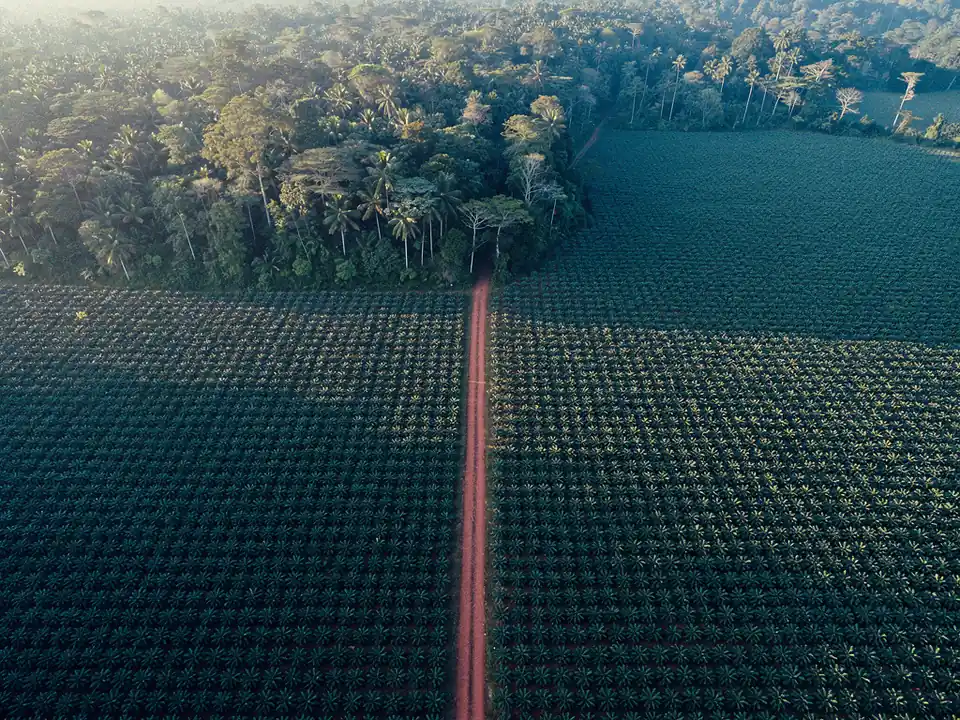
- Issuing certificates since 2004
- 500+ certificates issued
- On-site audits in the USA, Europe, Asia, Africa
- Verify any EUROTECH certificate
What is the EU Deforestation Regulation (EUDR)?
The EU Deforestation Regulation, Regulation (EU) 2023/1115, sets rules for seven commodities and the products made from them: cattle, cocoa, coffee, oil palm, rubber, soya and wood. A relevant product may only be placed on the EU market, made available on it or exported from it if it is deforestation-free, was produced in line with the relevant laws of the country of production, and is covered by a due diligence statement.
The regulation replaces the EU Timber Regulation and goes further. It asks for the geolocation of every plot of land where the commodity was produced, and for evidence that no deforestation took place there after 31 December 2020. EUDR is not a certification scheme: compliance is shown through due diligence and records, not through a certificate.
Which products does EUDR cover?
Scope follows the product list in Annex I of the regulation, which is organised by HS and CN customs codes. Containing a relevant commodity is not enough on its own: a product is in scope when its code is listed. Typical examples are:
- Wood: sawn timber, wood-based panels, furniture, pulp, paper and printed products, wooden packaging sold as a product
- Rubber: natural rubber and listed rubber products, including new pneumatic tyres (CN 4011)
- Cocoa and coffee: beans, cocoa butter and powder, chocolate, roasted coffee and listed coffee products
- Oil palm and soya: palm oil, palm kernel oil, soya beans, soya meal and listed derivatives
- Cattle: live cattle and beef
The product list changed in 2026. Delegated Regulation (EU) 2026/2102 removed cattle hides and leather and some rubber products, such as conveyor and transmission belts, narrowed the retreaded tyre code to tyre treads, and added products such as instant coffee, which follow a later date of 30 December 2027. We check each of your products against the current Annex I rather than against older lists.
Operators, traders and suppliers outside the EU
Obligations depend on your role. The operator that first places a product on the EU market, or exports it, carries out due diligence and files the due diligence statement (DDS) in the EU Information System. After the amendments in Regulation (EU) 2025/2650, downstream operators and traders have narrower duties, mainly collecting and keeping the reference numbers of the statements already filed. Micro and small primary operators can use a simplified declaration under conditions set in the regulation.
Manufacturers and exporters outside the EU have no statement to file, but their EU customers cannot file without their data. In practice, a rubber processor in Asia, a furniture maker in Turkey or a cocoa exporter in West Africa is asked for plot geolocation, production dates and legality evidence for each delivery. Our EUDR consultancy services cover both sides of that exchange.
What deforestation-free and legally produced mean
Deforestation-free means the commodity was produced on land that was not converted from forest to agricultural use after the cut-off date of 31 December 2020. For wood, it also means the wood was harvested without causing forest degradation after that date.
Legally produced means produced in line with the relevant laws of the country of production: land use rights, environmental protection, forest rules including forest management, third party rights, labour rights, human rights, the principle of free, prior and informed consent, and tax, anti-corruption, trade and customs rules.
EUDR due diligence in three steps
- Information (Article 9): product description and quantity, country of production, geolocation of all plots, production date or period, supplier and customer details, and evidence that the product is deforestation-free and legal
- Risk assessment (Article 10): a documented review of the risk of non-compliance, using criteria such as the country risk level, the presence of forests, the complexity of the supply chain, the risk of mixing with products of unknown origin, and concerns raised about the supplier
- Risk mitigation (Article 11): where the risk is not negligible, additional information, independent surveys or audits, and supplier support, until the risk is negligible
The Commission classifies countries as low, standard or high risk under Implementing Regulation (EU) 2025/1093. Sourcing only from low-risk countries allows simplified due diligence: the information still has to be collected, but the full risk assessment and mitigation steps do not apply unless there are signs of risk. Due diligence records must be kept for five years.
Geolocation requirements: points, polygons and GeoJSON
Every plot of land that contributed to a product must be identified by latitude and longitude. For plots of four hectares or less, a single point is accepted. For plots larger than four hectares, a polygon describing the boundary is needed. For cattle, the geolocation refers to the establishments where the animals were kept.
Coordinates use the WGS84 system with at least six decimal places. The EU Information System accepts geolocation in GeoJSON format, which is the format we deliver for each shipment. A correctly formatted file is only part of the work: the plots also have to be checked against forest loss data and linked to the products that were actually shipped.
Penalties for non-compliance
EU member states enforce the regulation through national authorities, which carry out risk-based checks on operators and traders. Penalties must be effective, proportionate and dissuasive. They include fines with a maximum of at least 4% of the company's total annual turnover in the EU, confiscation of the products and of the revenue gained from them, and temporary exclusion from public procurement. The actual amount depends on the breach and on national law.
Official EUDR sources
This page gives general information checked against official sources in November 2026. It is not legal advice for a specific product.
- Regulation (EU) 2023/1115 on deforestation-free products
- Regulation (EU) 2025/2650: simplification and new application dates
- Delegated Regulation (EU) 2026/2102: Annex I product scope
- Implementing Regulation (EU) 2025/1093: country risk classification
- European Commission: Regulation on deforestation-free products
Who our EUDR consultancy is for
Regulation (EU) 2023/1115 applies to products made from cattle, cocoa, coffee, oil palm, rubber, soya and wood. It covers businesses that place these products on the EU market or export them from it, and their suppliers outside the EU.
EU operators and traders
Companies that must file due diligence statements, or keep the reference numbers of statements filed upstream.
Non-EU manufacturers and exporters
Suppliers whose EU customers ask for EUDR data. Examples: tyres and rubber goods, paper and packaging, furniture, food ingredients.
Procurement and compliance teams
Teams that need a clear picture of supplier risk across products, countries and plots.
Not sure which of your products are in scope?
Send us your product list with customs codes. We tell you which products fall under EUDR and what your suppliers will need to provide.
What our EUDR consultancy covers
Eight service blocks, used together or on their own, depending on where your supply chain stands today.
1. Scope assessment
We review your products by HS/CN code and identify which products and raw materials fall under the regulation, with a written rationale.
2. Supplier engagement
We prepare and send supplier requests, follow up and check what comes back. Suppliers need no account or software. We can contact suppliers directly or through you.
3. Geolocation and plot verification
We collect and validate the plots of land where the commodities were produced, according to the regulation's geolocation requirements.
4. Deforestation screening
We screen each plot for forest loss after the 31 December 2020 cut-off date using satellite-based data. Every result is reviewed by an expert.
5. Risk assessment and mitigation
We run a documented risk assessment per supplier against the criteria of Article 10, and define mitigation measures where the risk is not negligible.
6. Traceability to the shipment
We link compliant raw material to production and to each shipment, so every delivery to the EU is backed by evidence.
7. Due diligence package for your EU customer
For each shipment we deliver a complete, audit-ready package: Annex II information, plot geolocation in GeoJSON format and supporting evidence. Your customer uses it to file the DDS and shares the reference number back.
8. Training and ongoing support
We train your team on EUDR obligations and keep your records up to date as suppliers, products and regulations change.
What your EUDR records look like
You see the state of your suppliers, plots, risk assessments and shipments at any time, without having to run the system yourself.
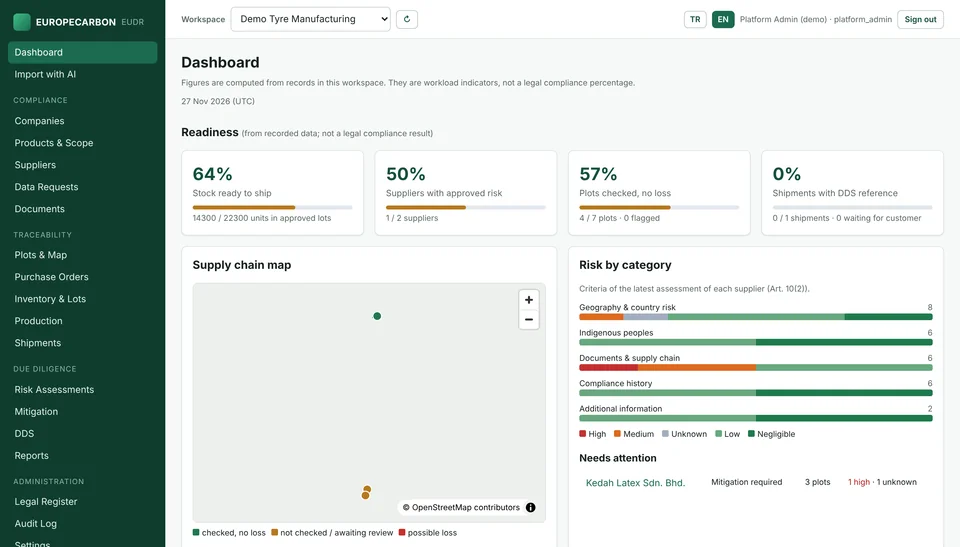
Readiness overview across suppliers, plots and shipments 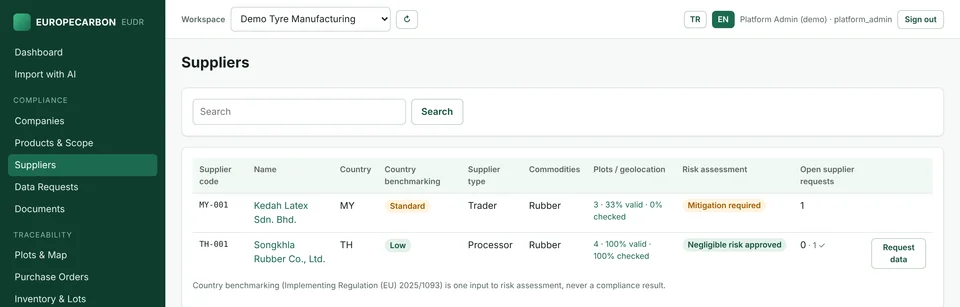
Supplier status, country risk and geolocation coverage 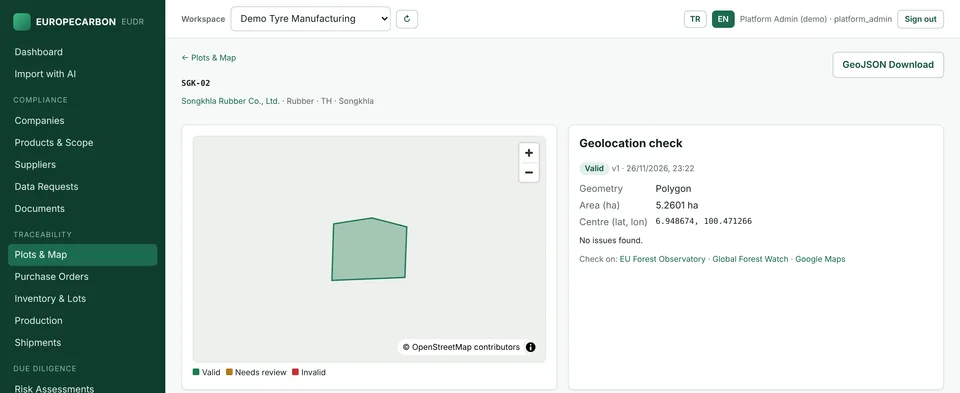
Plot-level geolocation checks 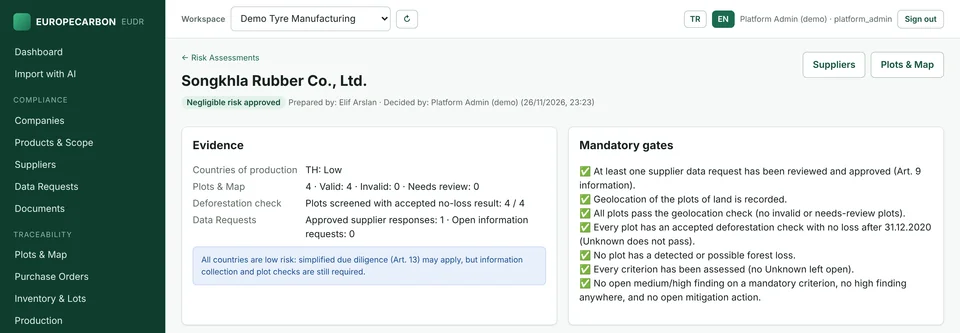
Documented risk assessment per supplier
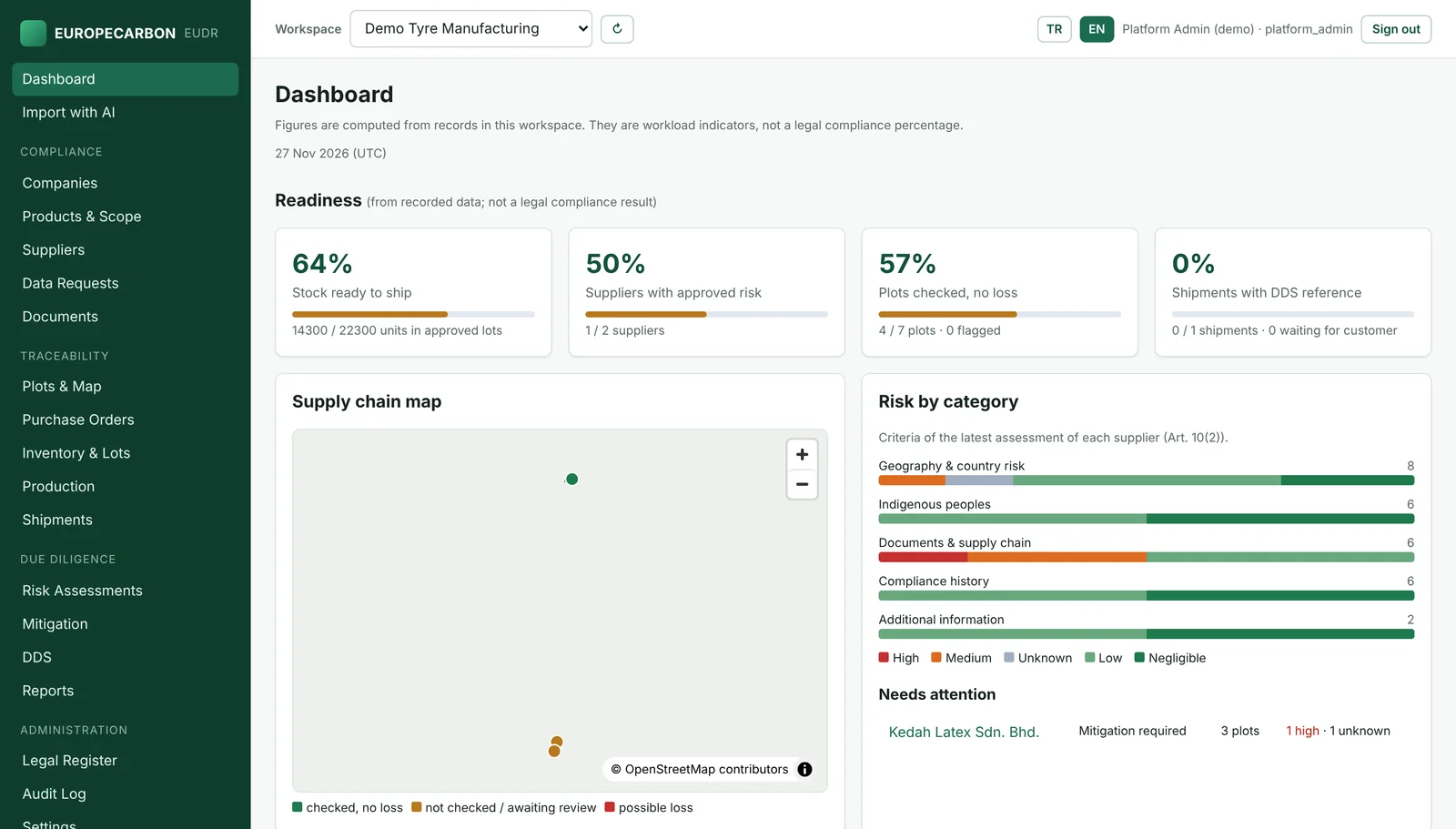
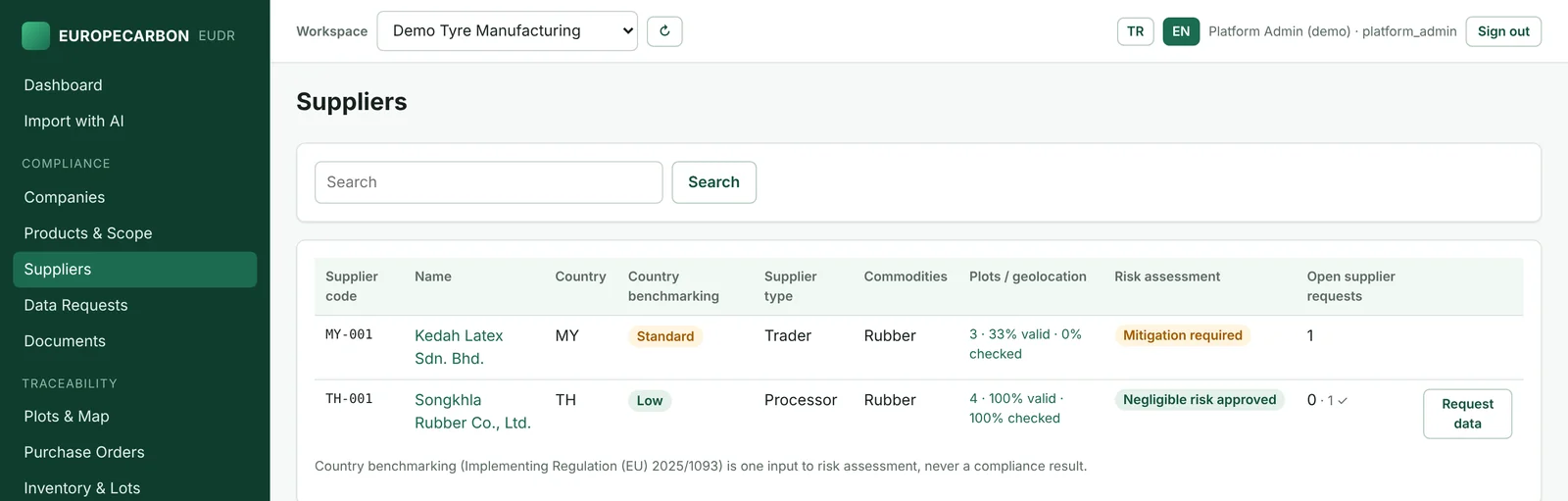
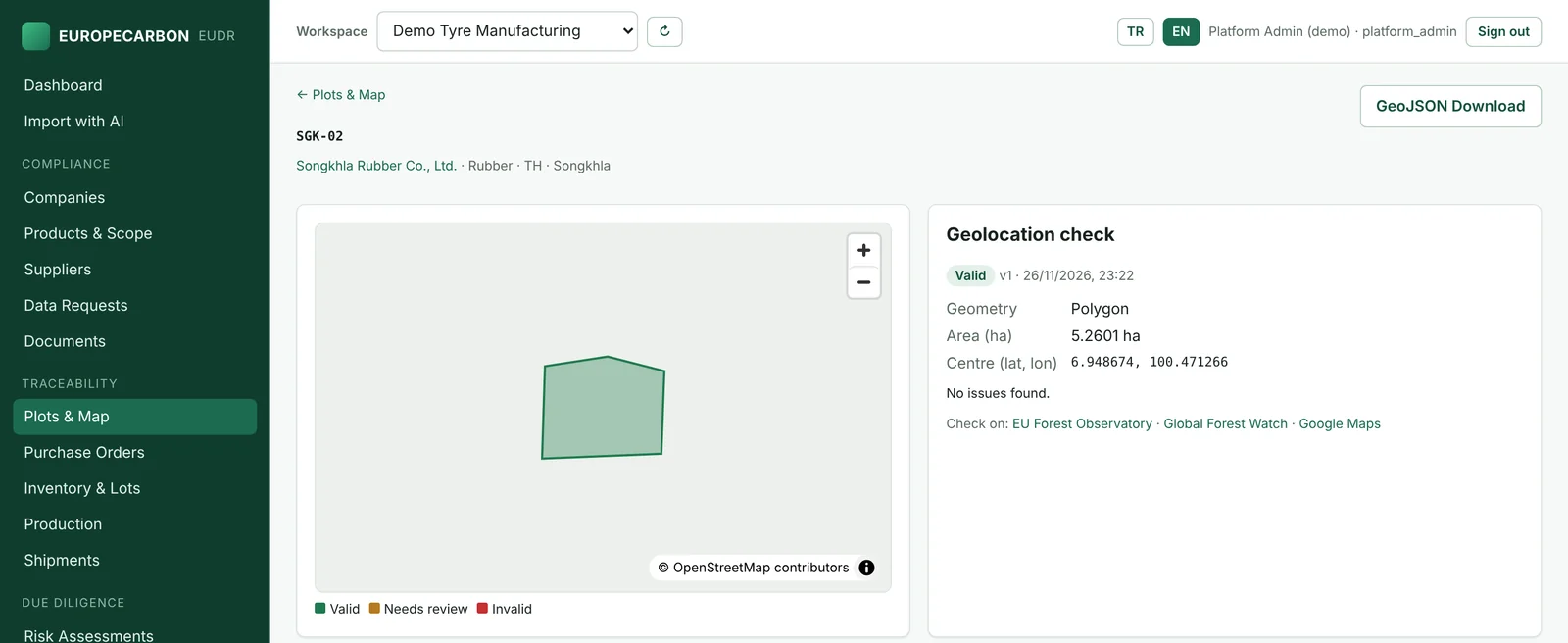
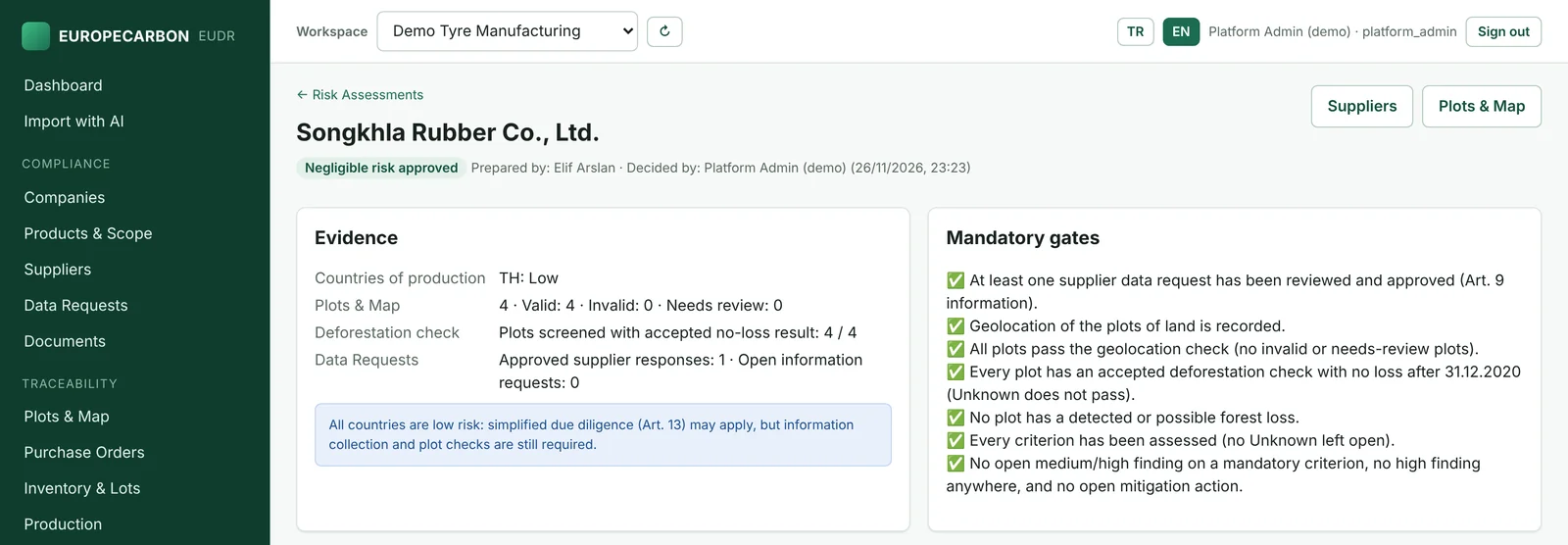
Illustrative screenshots with fictional data.
How we work
Four stages, from the first product list to shipment-level packages.
- 1
Assess
Scope, products and supply chain mapping.
- 2
Collect
Supplier data, documents and geolocation.
- 3
Verify
Screening, risk assessment and mitigation.
- 4
Deliver
Shipment-level due diligence packages and ongoing support.
What we collect
EUDR due diligence rests on a small set of data about each product and each plot. We keep the request short and specific to your products.
Product list and customs codes
Product descriptions with HS/CN codes, so scope can be set product by product.
Supplier details and countries of production
Who supplies each raw material and where it was produced.
Plot geolocation
Points or polygons for each plot of land, in line with the four-hectare rule.
Harvest or production period
The date or time range in which the commodity was produced.
Legality documents and certifications
Land use, permits and existing certifications such as FSC or PEFC.
Purchase, production and shipment records
The records that link raw material to finished goods and deliveries.
We collect information once and reuse it across shipments, so your team is not asked for the same data twice.
Why EUROTECH for EUDR
Service, not software
Our team does the work. You do not have to learn or maintain a new system.
Expert review at every step
Automated checks are reviewed and approved by a person.
Evidence you can show
Every decision is documented and traceable for audits and customer requests.
Confidential by design
Supplier data is handled confidentially and shared only where the regulation requires it.
One partner for related schemes
FSC chain of custody, EcoVadis ratings and ISO 14001 from the same team, using the same supplier evidence where it fits.
Clients on four continents
We work with companies in the USA, Europe, Asia and Africa, on both sides of the EU supply chain.
Start with a free scope review
Send us your product list and we will tell you which products are in scope and what your suppliers will need to provide.
EUDR compliance: frequently asked questions
Does my product fall under EUDR?
It depends on its HS/CN code. Containing a relevant commodity is not enough on its own. We assess this product by product.
We are outside the EU. Do we need to comply?
The EU operator files the statement, but it needs your data. Without it, your customer cannot place your products on the EU market.
Are certifications such as FSC or PEFC enough?
They support the assessment but do not replace geolocation and deforestation checks. If you also need FSC, see our <a href="/services/fsc-certification/">FSC certification</a> service.
What if our suppliers buy from many smallholders?
We work along the chain with processors and traders, which usually hold plot lists, and we document the complexity in the risk assessment.
Do you file the DDS for us?
No. The operator files it in the EU Information System. We prepare a complete package for that filing.
Is there an EUDR certificate?
No. The regulation does not create a certificate or an approval mark. Compliance is shown through due diligence, the due diligence statement and the records behind it. Be careful with offers of an "EUDR certificate".
When does EUDR apply?
From 30 December 2026 for large and medium-sized companies, and from 30 June 2027 for most micro and small enterprises. Products added to Annex I in 2026 follow from 30 December 2027. Some micro and small companies already covered by the EU Timber Regulation follow the December 2026 date. We confirm the date that applies to you.
What is the EUDR cut-off date?
31 December 2020. Commodities must come from land that was not deforested after that date, and wood must come from forests that were not degraded after it.
What geolocation format does EUDR require?
Latitude and longitude in WGS84 with at least six decimal places. A point is enough for plots of four hectares or less; larger plots need a polygon. The EU Information System accepts GeoJSON files, which is the format we deliver.
Does a low-risk country mean no due diligence?
No. Products from countries classified as low risk qualify for simplified due diligence, but the information, including geolocation, still has to be collected and kept.
How long must EUDR records be kept?
Five years from the date the due diligence statement was filed or the product was supplied.
What does EUDR consultancy cost?
It depends on the number of products, suppliers and plots, and on how much data already exists. The first scope review is free; after it we send a written quote.
Related services
- FSC certification
From $2,000
- EcoVadis consultancy
From $1,500
- ESG reporting
From $2,500
- ISO 14001 certification
From $800
- GLOBALG.A.P.
From $2,000
Request a quote for EUDR consultancy
Tell us your company, sites and the standard you need. We reply with a written quote and the audit plan.
Prefer to talk? Call +1 307 205 1833
Monday to Friday, 09:00 to 18:00 (US Mountain Time)